
Creatine HCL vs Monohydrate
Creatine is the most studied, most reliable performance supplement on the market — hundreds of trials support its benefits for strength, power, training volume and recovery. The question isn't whether to take creatine; it's which form. The two you'll see most are creatine monohydrate and creatine hydrochloride (HCL) — so let's settle the comparison with what the research actually says.
Do they actually work differently? The evidence says no
This is the part the marketing usually skips. When researchers test the two head-to-head — most recently Londoño-Velásquez and colleagues (2025, Journal of the International Society of Sports Nutrition), comparing 5 g/day of each over eight weeks in trained athletes — both forms improved performance, with no meaningful advantage for HCL. The authors concluded that claims of HCL superiority are unfounded. The ISSN's official position stand (Kreider et al., 2017) likewise calls monohydrate the most effective and best-evidenced form, with no alternative shown to beat it. So if you're choosing on results, it's a tie — and monohydrate has the mountain of data behind it.
What they have in common
Both deliver creatine to your muscles, where it helps regenerate ATP — the energy currency for short, explosive efforts. Both increase strength, power and lean mass over time when paired with training, and creatine is one of the safest supplements ever studied. Monohydrate is also already almost completely absorbed, so nothing dissolves "better" into your muscles than it already does.
Creatine monohydrate
Pros: the most-researched form by a wide margin, effective, and inexpensive. If value is your priority, it's the obvious pick.
Cons: lower water solubility, so it can be gritty in the glass. Some people report bloating — but that's largely tied to the old "loading phase" (around 20 g/day for a week), which you can simply skip. At a steady 3–5 g a day, the bloating complaint mostly disappears.
Creatine HCL
Creatine HCL binds creatine to hydrochloric acid, which makes it far more water-soluble.
Pros: it dissolves cleanly with no grit, mixes into a smaller volume of liquid, and needs no loading phase — a genuinely nicer daily experience, especially if gritty monohydrate shakes are what stop you taking it consistently.
Cons: it costs a bit more and has far less direct research behind it. And to be straight: while many people find it easier on the stomach, there isn't strong trial evidence that HCL reduces stomach issues versus a sensible 3–5 g monohydrate dose. The honest case for HCL is mixing and convenience — not superior results.
So which should you take?
- Choose monohydrate if you want the most-proven option at the lowest cost and don't mind a slightly gritty shake.
- Choose HCL if clean mixing, a smaller dose volume and no loading make you more likely to take it every single day — which is what actually drives results.
Both work. The best creatine is the one you'll take consistently — including rest days, since the goal is to keep your muscles saturated over time, not to "feel" it acutely. Either way, 3–5 g daily is all you need, and no loading phase is required.
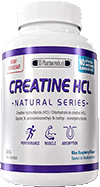
If clean mixing and stomach comfort are what keep you consistent, Creatine HCL gives you a highly soluble daily dose with no loading phase. Pair it with smart training and your recovery fundamentals for the best results.
Key references: Kreider RB, et al. J Int Soc Sports Nutr. 2017;14:18 (PMID 28615996). Londoño-Velásquez et al. J Int Soc Sports Nutr. 2025 — direct creatine monohydrate vs HCl comparison.
Creatine HCL
Highly soluble, easy on the stomach, no loading phase required. A clean daily dose for strength and recovery.
This article is for educational purposes only and is not medical advice. Dietary supplements are not intended to diagnose, treat, cure or prevent any disease. Consult a qualified healthcare professional before starting any supplement, especially if you have a medical condition or take medication.